
'Those satisfied with returns and not expecting further rally could be booking profits and also stopping SIPs.'

Markets ended lower on Thursday following the expiry of July derivative contracts weighed down by profit taking in FMCG shares after recent gains.

The sharp rally in the broader markets has propelled India's market capitalisation (m-cap) to a new high. The combined m-cap of all BSE-listed firms rose to Rs 291.9 trillion in intraday trade on Thursday before settling lower at Rs 290.9 trillion. The previous record was on December 14, 2022, at Rs 291.3 trillion.
Firms denied peer review certificate may be barred from auditing
The Bombay Stock Exchange's 30-share Sensex closed at 19,504 up 117 points. The National Stock Exchange's 50-share S&P CNX Nifty closed up 26 points at 5,930.
Government is set to release CPI for the month of May and Index of Industrial Production IIP for the month of April today.

Riding the wave of the equity market, the mutual fund (MF) industry experienced double-digit growth in Samvat 2079, concluding the Hindu calendar year close to the Rs 50 trillion assets under management milestone. After a subdued 6 per cent growth in Samvat 2078, the industry's assets surged over 18 per cent last year to Rs 46.7 trillion. Industry players anticipate that Samvat 2080 will also be a fruitful year for the asset management industry, given the strong inflows from retail investors, particularly through the systematic investment plan route.

The Nifty rose by 32.40 points to 6,135.85, after touching the day's high of 6,187.75.

BSE- mid-cap & small-cap outperformed benchmark indices

Despite the possibility of the economy bottoming out, the investment cycle could remain weak for another couple of years and earnings downgrades should continue.
The Sensex ends up 16 points to end at 20,514.

BSE-IT, capital goods, banks, real-estate led gains.

Among major Sensex shares, PowerGrid fell the most by 2.76 per cent. IndusInd Bank dropped 2.34 per cent, HUL by 2.23 per cent and NTPC by 2.04 per cent. ICICI Bank, HDFC Bank, HDFC, ITC, Infosys, L&T, Bajaj Finance, Kotak Bank, HCL Tech and Tech Mahindra were among the losers. On the other hand, Tata Motors rose the most by 2.94 per cent, followed by Titan which gained 1.26 per cent. Mahindra & Mahindra, SBI and TCS were also among gainers.
The Bombay Stock Exchange's 30-share Sensex closed at 18,401 up 405 points. The National Stock Exchange's 50-share S&P CNX Nifty closed at 5,409 up 124 points.

While Nifty 50 reflects changes in 40 years, it also shows what is missing: Low-cost manufacturers at one end, and deep-value players at the other. Also missing are technology players, observes T N Ninan.
BSE Metal, IT and Consumer Durable indices surged by nearly 2% each. However, BSE FMCG index declined by nearly 1%.

The proposal to merge the Gujarat International Finance Tec-City (GIFT City) units of the National Stock Exchange (NSE) and BSE has reached an advanced stage, and both bourses could file an application before the National Company Law Tribunal as early as this month, according to a top regulatory official. Sources indicate that the merger proposal has received approval from their respective boards. Both the NSE and BSE are arch rivals when it comes to onshore trading.
The country's two ubiquitous financial powerhouses, HDFC and ICICI Bank, have been the darling of participatory notes, the instrument through which overseas investors invest indirectly - through foreign institutional investors - in India's stock market. Among the stocks comprising Bombay Stock Exchange's Sensitive Index and National Stock Exchange's S&P Nifty, HDFC has the highest P-Notes holding in value, 14.2 per cent, followed by ICICI Bank's 9.1 per cent.
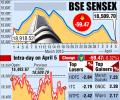
BSE-FMCG, consumer durables, pharmaceuticals led declines.
BSE-real-estate, bankex, auto lead gains on BSE.

Benchmark share indices ended nearly 2% down on Monday, amid weak cues from Asia and Europe, with index heavyweight Infosys leading the decline

The Rs 6,560-crore initial public offer of Bajaj Housing Finance Ltd received 63.60 times subscription on September 11, the last day of bidding, amid overwhelming participation from institutional buyers. The initial share sale had a price band for the offer at Rs 66-70 per share.

Indices across Indian equity markets have edged towards new record highs before undergoing a small correction in the past few sessions. The National Stock Exchange Nifty has gained 20 per cent in the past year; mid-caps (up 33 per cent), small-caps (up 31 per cent), and micro-caps (up 44 per cent) have done better. Several factors have precipitated this rally.

Reminiscent of the past two years, the market has made positive strides ahead of the Union Budget 2023-24 (FY24). The benchmark National Stock Exchange Nifty has gained 1.8 per cent in the last month. Typically, markets tend to gain ahead of the Budget as investors build in optimism.
Markets continued to trade on a volatile note in afternoon deals, ahead of the futures and options expiry on Thursday. The Sensex is up32 points at 16,999. Nifty is up five points at 5,146.

Rakesh Jhunjhunwala sounded another note of caution on the nature of the latest bull run.

Sensex zooms 200 points in Muhurat trading, Nifty regains 7,800.
The Bombay Stock Exchange benchmark Sensex sank by 951 points on black Monday on panic selling by funds, triggered by weak global cues.

National Stock Exchange index Nifty shot up 50 points to 4,756.45.

'Trading is about psychology; 75% of it is about keeping your emotions in check.'

sustained inflow of foreign funds kept the market in a cheerful mood.

Two equity funds at the opposite ends of the risk matrix - small-cap and arbitrage - bucked the 'low inflow' trend in May this calendar year 2023 (CY23) to receive the highest net inflows in recent years. The Rs 3,280-crore net inflows into small-cap schemes in May was the highest for the category since the mutual fund (MF) industry started releasing fund-wise inflow data in April 2019. Arbitrage schemes raked in a net Rs 6,640 crore - the highest since July 2021.

Stocks of public sector companies, especially the oil refining and marketing companies (OMCs) - Bharat Petroleum Corporation Limited (BPCL), Hindustan Petroleum Corporation Limited (HPCL) and Indian Oil Corporation Limited (IOC) - logged gains on Tuesday in a weak market. While the Nifty lost nearly 1 per cent in trade on Tuesday, the Nifty CPSE index - a gauge of performance of central public sector enterprises on the National Stock Exchange (NSE) - gained over 3 per cent in intra-day trade. The rally in PSU stocks comes on the back of the BPCL chairman, Arun Kumar Singh suggesting in the company's annual general meeting (AGM) on Monday that the government intends to complete the divestment process in the OMC by March 2022.

Government-owned companies are more generous in rewarding their shareholders with dividends.
On the last day of Satyam's stint in India's benchmark indices - the Bombay Stock Exchange Sensex and the National Stock Exchange S&P CNX Nifty - its shares turned out to be a punter's delight.

Among Sensex stocks, Tata Motors rose the most by 2.79 per cent. NTPC, Reliance Industries, Infosys, TCS, HDFC twins, Tata Motors, ITC, Power Grid and Bajaj Finserv were among the major gainers. Tata Steel fell the most by 1.22 per cent. L&T, Sun Pharmaceuticals, IndusInd Bank and Ultratech Cement were among the losers.
The Sensex traded lower by 536.19 points at 15,240.12 at noon with most heavy-weight stocks plunging to recent lows. Similarly, the second wide-based National Stock Exchange index Nifty dropped by 173.10 points at 4446.70.

Mutual funds (MFs) have stepped up equity purchases after staying on the fence for over two months. Their net equity investments reached a four-month high of Rs 7,700 crore in July, rising for the fourth consecutive month after withdrawing a net of Rs 5,100 crore in April 2023. This trend continued in August, with net investments of Rs 3,400 crore in the first three trading sessions, according to data from the Securities and Exchange Board of India.

Rise in investor sentiment, return of risk appetite aid shares across the board

The National Stock Exchange index Nifty gained 3.75 points at 4,572.30. It touched the day's high of 4,596.75 and a low of 4,528.50 points. Among the 30 Sensex stocks, 14 closed with losses while 16 gained. Overseas funds bought stocks of a net $146.6 million on July 23, taking total investments in equities this year to $6.57 billion.
 © 2026 Rediff.com - Advertise with us - Disclaimer - Privacy Policy - Sitemap - Feedback - About us - Terms of use - Grievances